SKOG welcomes you to exhibitions by Tamara Marbl, Oscar Furunes and Aron Irving Li in SKOG. Vernissage on Friday 9 October at 18:00h.
Fractal Moments by Aron Irving Li
In the exhibition Fractal Moments, Aron Irving Li explores fractal principles and repeating form. Through systematic processes, he constructs metal objects that reference the plant world.
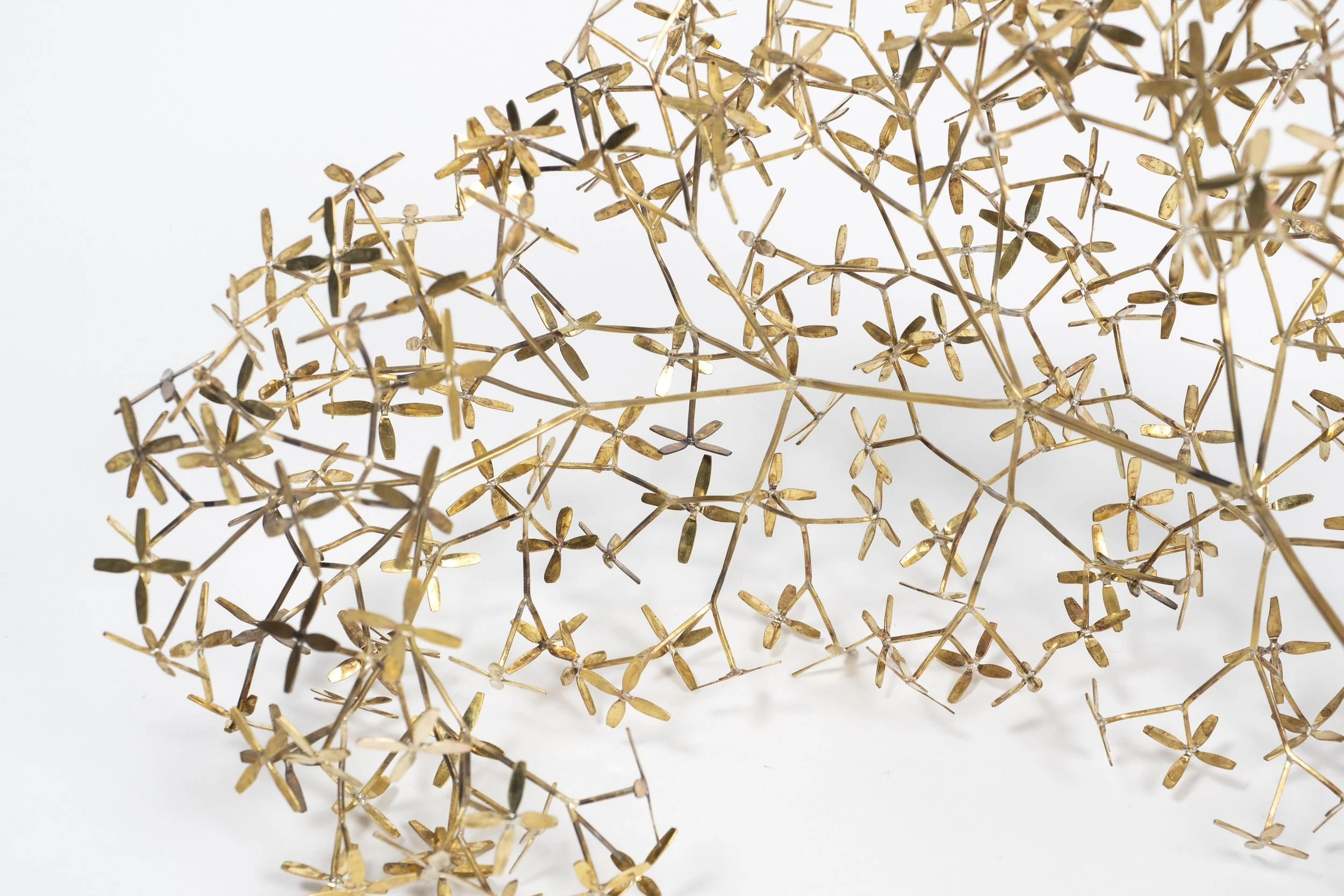
A fractal is a geometric form whose structure reproduces itself at different scales. A single element, observed on its own, looks like the original figure as a whole. Many phenomena in nature have fractal traits, such as the geometric structure of a tree, or the blood vessels and nerve pathways of the human body.
Li approaches the fractal through hands-on investigation. He explores how form can be built from many small individual elements, and how repetition as a method gives rise to dynamic expression. Made in brass and copper, the objects appear as complex, fragile structures with a pronounced organic character. Li solders together hundreds of wire-based elements. This creates a kind of growth process within the construction itself, as each object is gradually built up piece by piece. The process allows the objects to be extended and developed continuously over time.
Some works balance at the very limit of the material’s stability, so that the slightest movement travels through the work like a tremor. That movement gives a sense of something living, fragile and transient. Recurring in several works is the simple principle of branching. It is a form found in many natural structures, and for Li it refers to nature’s life force and cycles.
ABOUT THE ARTIST
Aron Irving Li (b. 1989, Sweden) is an Oslo-based metal artist. He graduated from the Oslo National Academy of the Arts in 2015, where he now works as an assistant professor in Metal and Jewellery Art. Through sculpture and objects, Li explores artistic expression where craft methods, material properties and nature’s formal language meet. He has held several solo and group exhibitions at venues including Format Oslo, Vestfold Kunstsenter, Buskerud Kunstsenter and Kunstbanken Centre for Contemporary Art. Li has also completed public art commissions in Skudeneshavn, Oppdal and Fornebu. His work is held in the collections of the National Museum of Norway, KODE, the Nordenfjeldske Museum of Decorative Arts and Design, and the City of Oslo, among others.
Laurensius Celvi anus Petri by Oscar Eriksson Furunes
Text by Maria Esmeral
There is something valuable when looking into the past, the instant that just vanished or a period very far away, and how we tie it to the present. The stones before you are originals from Nidaros Cathedral (constructed between 1070–1300 and restored several times afterward). In 2019, artist Oscar Eriksson Furunes acquired the first of these stones while studying at the Malmö Art Academy. Working with historically charged artifacts will become a constant in his methodology, whether they come from more recent times, like perfume lamps from the 1920s as part of the work Night Watch, or from the medieval era, like these stones. As he says himself, “he reinterprets historical materials into installations in which he incorporates personal references, gestures, and codes [...].”[1] In the case of these stones, Furunes’s personal link with the cathedral coexists (he was baptized there) with this building’s historical weight in Norwegian heritage.
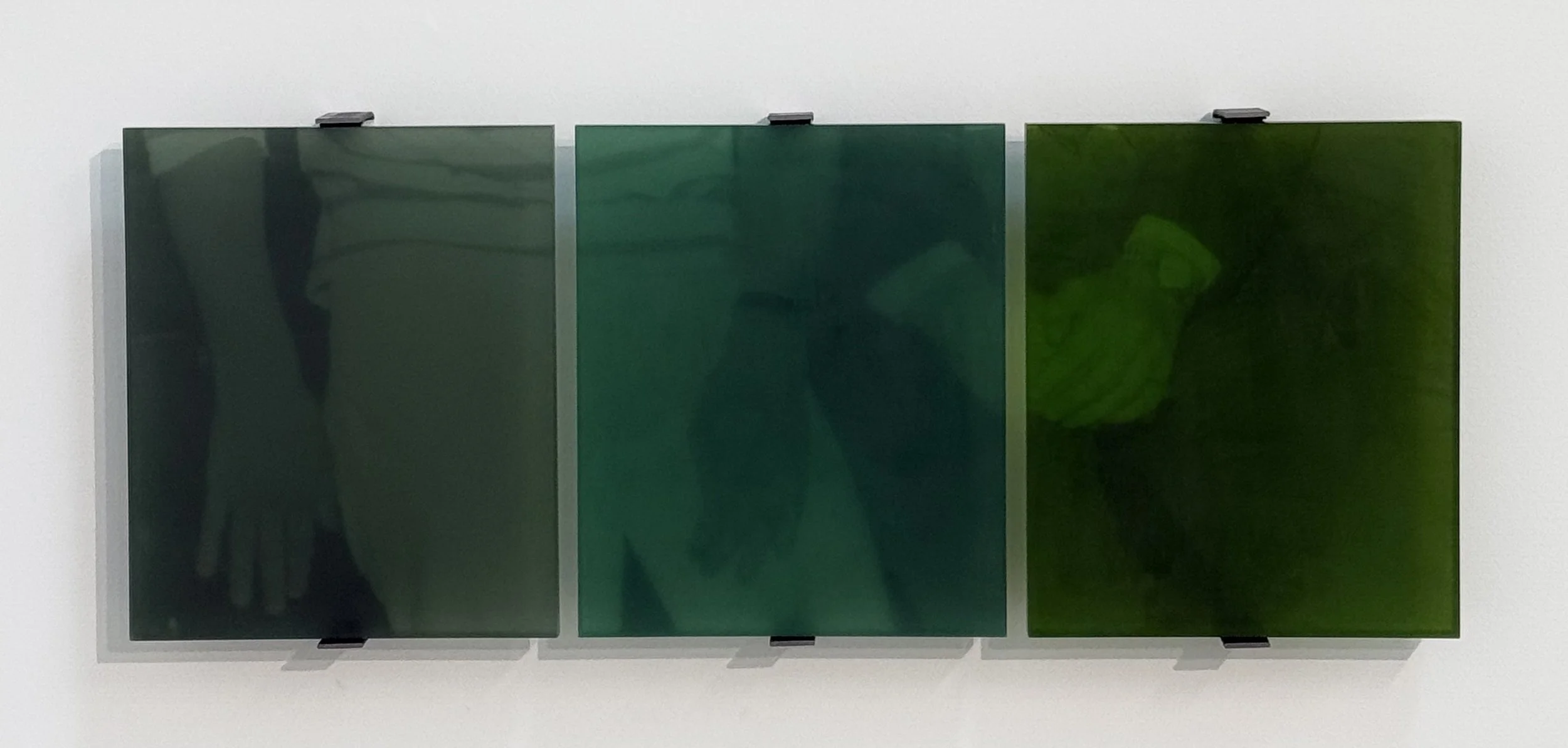
The starting point of this series is a Latin inscription present in the walls of the cathedral. Carved in the stone, the phrase reads “Laurensius Celvi anus Petri.” Archaeologists date the inscription to the late 13th century. The phrase can be translated as “Lars is Peter’s arse.” So, who were these men? The first name, Lars, refers to Laurentius Kálfsson (1267–1331), an Icelandic bishop of the diocese of Hólar. The second name, Peter, refers to Peter Gudleiksson of Eid (1240/60–ca. 1308), a Norwegian nobleman and knight sent to Iceland in 1293.[2] The two men meet in Hólar and travel together to Trondheim shortly after. These events are narrated in the Laurentius saga, a text written most likely in the third quarter of the 14th century. In the saga, Laurentius is received in Norway by Archbishop Jørund of Nidaros ([n.d.]–1309) and becomes his disciple and protégé. At that time, existing conflicts between the archbishop and the cathedral chapter had been brewing. It is within this context that this Latin inscription appears. Although the saga does not explicitly describe the relationship between Laurentius and Peter as anything more than a close friendship, it is important to bear in mind that Latin was a foreign language, mainly exclusively spoken and written by clerics across Europe during the medieval period, and that churches, as buildings, were the centers of social interaction, both for the clerical and secular sides of society. Therefore, this is an act of extreme violence and public shaming. Even if the saga says that the archbishop sends Laurentius on a mission back to Iceland, it is also very likely that, as a result of the accusations and bullying, Laurentius returned to Iceland, where he became bishop of Hólar.
The inscription “is an early example of bottom-shaming and an important document in Norwegian queer history. […] Bottom-shaming refers to the denigration of the receptive or penetrated partner in a sexual encounter between men. This historical stigma coincides with many men’s fear of being penetrated and is also a product of patriarchal social norms and homophobia with deep historical roots, including those associated with the Church.”[3]
In an exercise of beautiful material poetry, Oscar Eriksson Furunes creates a series of pieces filled with deep historical and personal meaning, where collective and individual narratives converge at the same time as a very distant past and the present coexist. To this, we add the historical weight and relevance of the materials themselves. The millenary relationship between stone and glass, and the contrast between petroglyphs, or writing in stone, and photography, which is the imprint of light at a specific moment and that shifted human perception of reality forever.
Stone carving is one of the most ancient and durable ways of safeguarding information for the future. It is known to everyone who sculpts stone that, inside the stone, there is something to be found. For Furunes, there is beauty in the contrast between the outer layer, exposed to cold, heat, rain, wind, and acidic bird poop. In other words, time. And the inner layer, one could say brand new or unseen, of the stone when it is sliced. To anchor his reasoning in the present, Furunes introduces contemporary words: “In the recently exposed cut surfaces of the stones from the cathedral, words in various languages can be seen carved into the stone. These are derogatory terms that have been, or continue to be, used to describe men who are referred to as ‘bottoms’ in the dichotomies between top and bottom, passive and active.”[4]
Laurensius Celvi anus Petri by Oscar Eriksson Furunes is a coded meditation with several layers of meaning, each deeper than the one before. Finally, one could wonder about the color green. Is it the green of the moss and plants that, with time, grow on the surface of stones and stone buildings? With roots that penetrate them? The green of life itself? A green carnation, in reference to Oscar Wilde, that has always been there. Way before thoughts and words, standing in plain sight, and that will always exist because it is inherent to the experience of being alive.
The exhibition has received project funding from Arts and Culture Norway.
Special thanks to Nidaros Cathedral Restoration Workshop (NDR), Øystein Digre, and researcher and archaeologist at NDR, Øystein Ekroll.
[1]Oscar Eriksson Furunes.
[2]These dates are uncertain.
[3]Oscar Eriksson Furunes.
[4]Oscar Eriksson Furunes.
ABOUT THE ARTIST
Oscar Eriksson Furunes (b. 1991, Oslo) is a Norwegian-Swedish artist. He graduated from Malmö Art Academy in 2023. In his artistic practice, he reinterprets historical materials into installations in which he incorporates personal references, gestures, and codes through queer perspectives. He explores the boundaries between, and points of intersection within, what we perceive as individual/personal histories and collective/public histories or events. In 2024, he received Høstutstillingsprisen for his work Night Watch at the Artists’ House in Oslo.
In recent years, he has exhibited at venues including Møstings Hus, Martin Asbæk Gallery and Bonne Espérance in Copenhagen, Gerdman Gallery in Stockholm, Galleri Arnstedt in Båstad, Kohta Taidehalli in Helsinki, and the Hannah Ryggen Triennial 2022 in Trondheim. He has recently participated in group exhibitions at Malmö Art Museum and Inside-Out Art Museum in Beijing, both curated by Jacob Fabricius. Furunes’ works are in the collections of Trondheim Art Museum and Malmö Art Museum.
Yellow Press by Tamara Marbl Joka
The term “yellow press”, meaning sensationalist journalism, emerged in the late 19th century. Newspapers began competing for readers with large headlines, dramatic stories and often uncritical use of sources. At the same time, technological changes in the printing industry made newspaper production cheaper and faster.
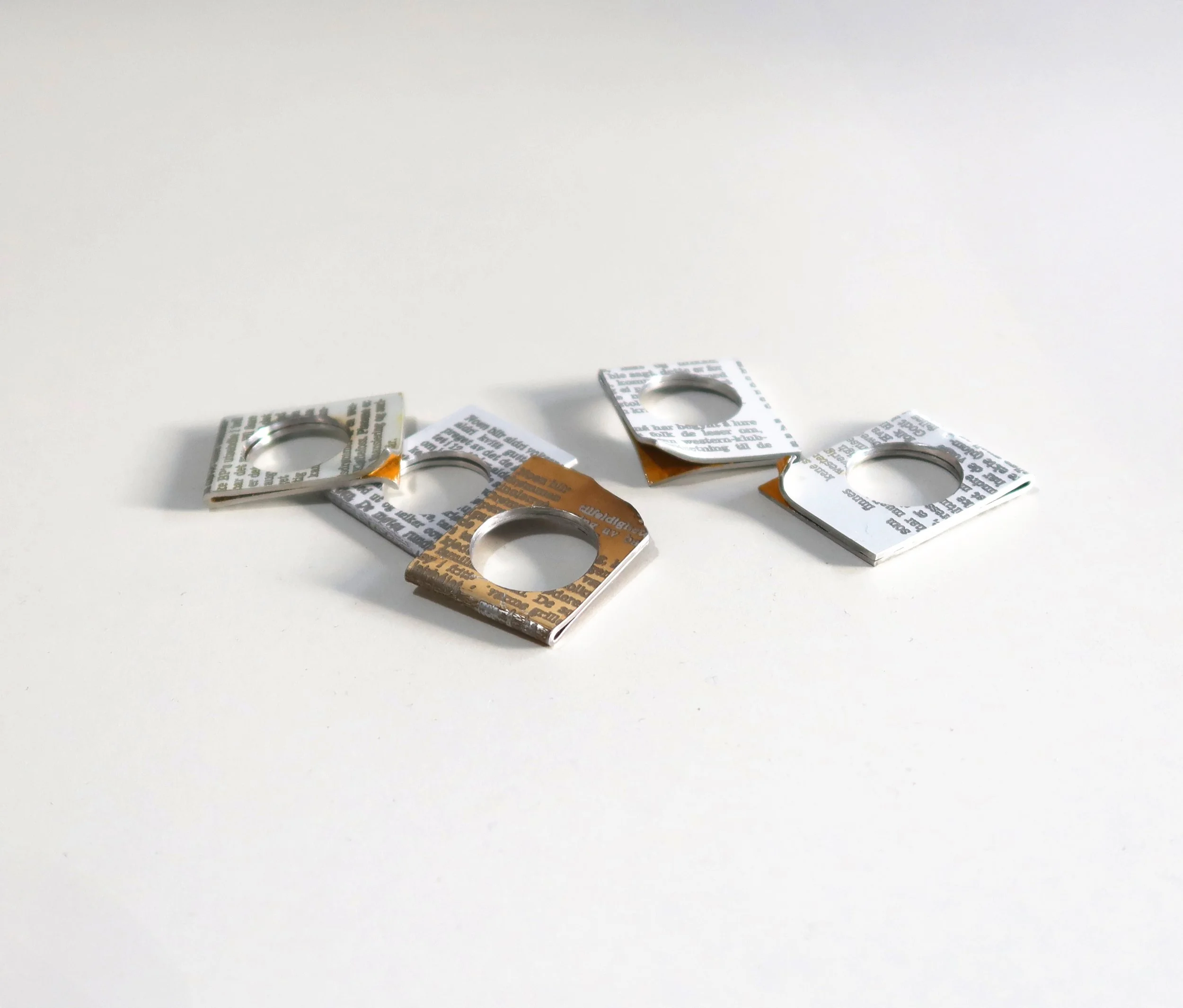
An important link to aluminium lies in printing technology. Aluminium came to be widely used for printing plates, especially in offset printing, because the metal is light, durable and suited to fast mass production. This made it possible to print large runs of newspapers quickly and at lower cost.
As newspapers became cheaper and easier to produce, competition for readers grew. This contributed indirectly to the rise of the yellow press, as some newspapers chose more sensational and eye-catching stories to sell more copies. In this way, technological development in aluminium and the development of sensationalist journalism are bound together.
Although the phenomenon emerged in the late 19th century, many of the same mechanisms remain clearly visible in today’s media landscape.
ABOUT THE ARTIST
Tamara Marbl Joka (b. 1968) is an Oslo-based metal and jewellery artist. She graduated from the Oslo National Academy of the Arts in 2024 with a master’s degree in Metal and Jewellery Art, following an earlier master’s in Art and Crafts from the University of South-Eastern Norway in 2009. She has held solo and group exhibitions at venues including Format Oslo, the Annual Exhibition of Norwegian Crafts at the National Museum, SCHMUCK in Munich, the Lisbon Contemporary Jewellery Biennial and the International Jewellery Competition in Legnica. Joka received the Herbert Hofmann Prize in 2023 and a working grant from Arts Council Norway in 2025. Her work is held in the collections of the Nordenfjeldske Museum of Decorative Arts and Design in Trondheim and Die Danner-Stiftung in Munich, among others.