Get to know: Iver Lennartson Noem
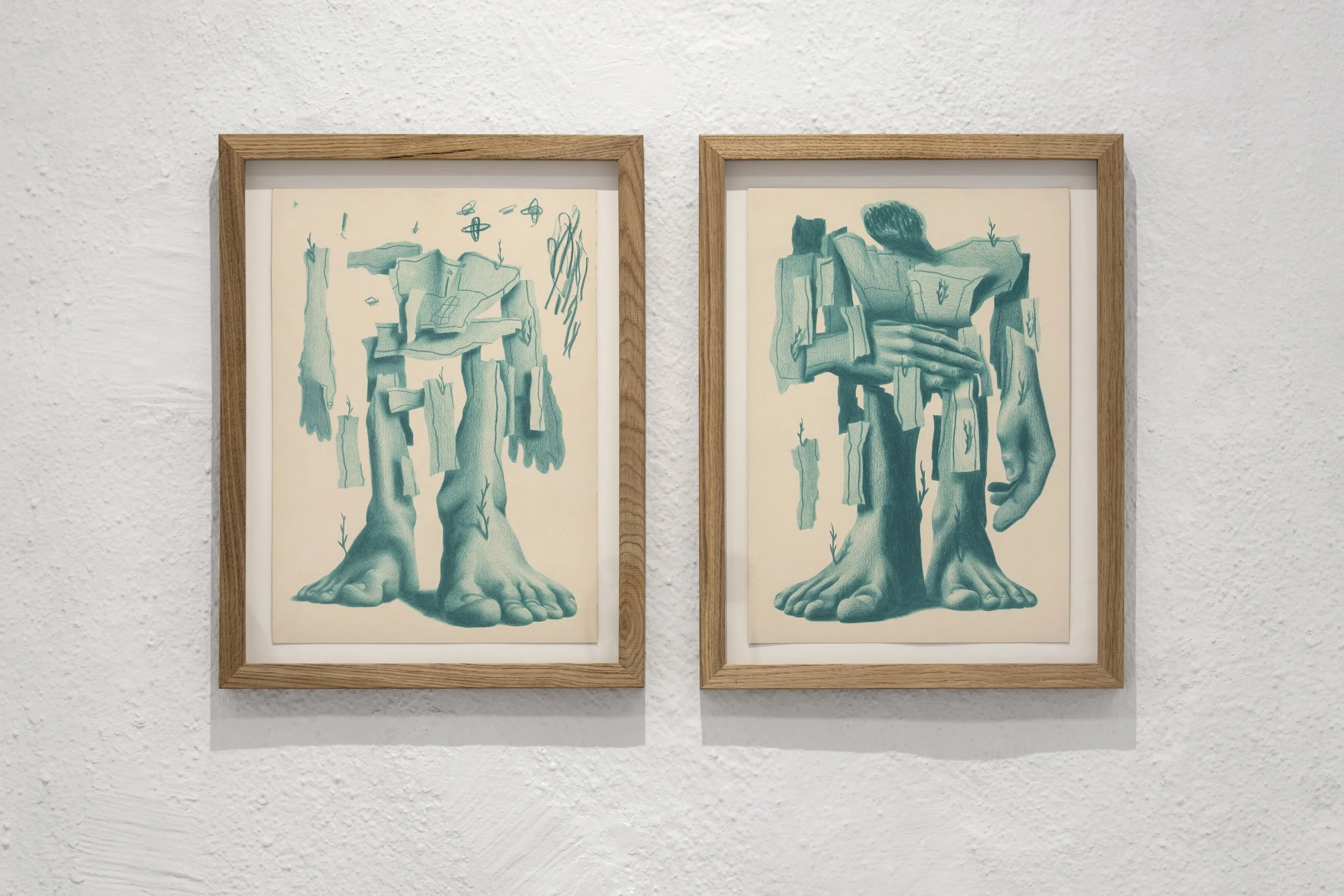
Fra venstre: “Framvekst”, 2026. Polychromo on Fabriano cottonpaper (ivory). 25×35cm.
“Vørti”, 2026. Polychromo on Fabriano cottonpaper. 25×35cm.
On show at SKOG until 3rd of May.
Personality
Process
Perspective
Q&A w/ IVER LENNARTSON NOEM:
Personality Process Perspective Q&A w/ IVER LENNARTSON NOEM:
Describe your art in three words!
Whimsical, allegorical – melancholy!
What first got you into art?
It’s hard to point to a single moment, but I’ve always had images in my head that I felt compelled to create. When something exists clearly in your imagination, you feel the need to bring it into the world. I guess for me, art became a way of materializing those inner images.
When did you start to feel this was something you wanted to pursue seriously?
In high school, I think. I actually leaned more toward architecture, but since I felt there wasn’t enough room to focus on creativity, I eventually went more with art.
Earlier, in elementary school, I had a formative experience: we were introduced to modern art and asked to choose an artist. I made a work inspired by the well-known Norwegian artist, Pushwagner, and my teacher later sent my work to him. He responded saying; «J*vlig kult!», which made me realize that art might be something I could pursue.
What experiences have shaped you most as an artist?
Discussing art, getting feedback through schooling, plus going to openings and meeting other artists have been crucial. I’ve also been influenced by a supportive family, friends and teachers along the way. I feel as though creativity has been a way to connect to myself and others through play, bridging the gap between the imaginary and life. That creativity has helped me shape the way I navigate the ups and downs of growing up and being in this state of becoming.
Where do you find inspiration right now? Are you working on anything in particular?
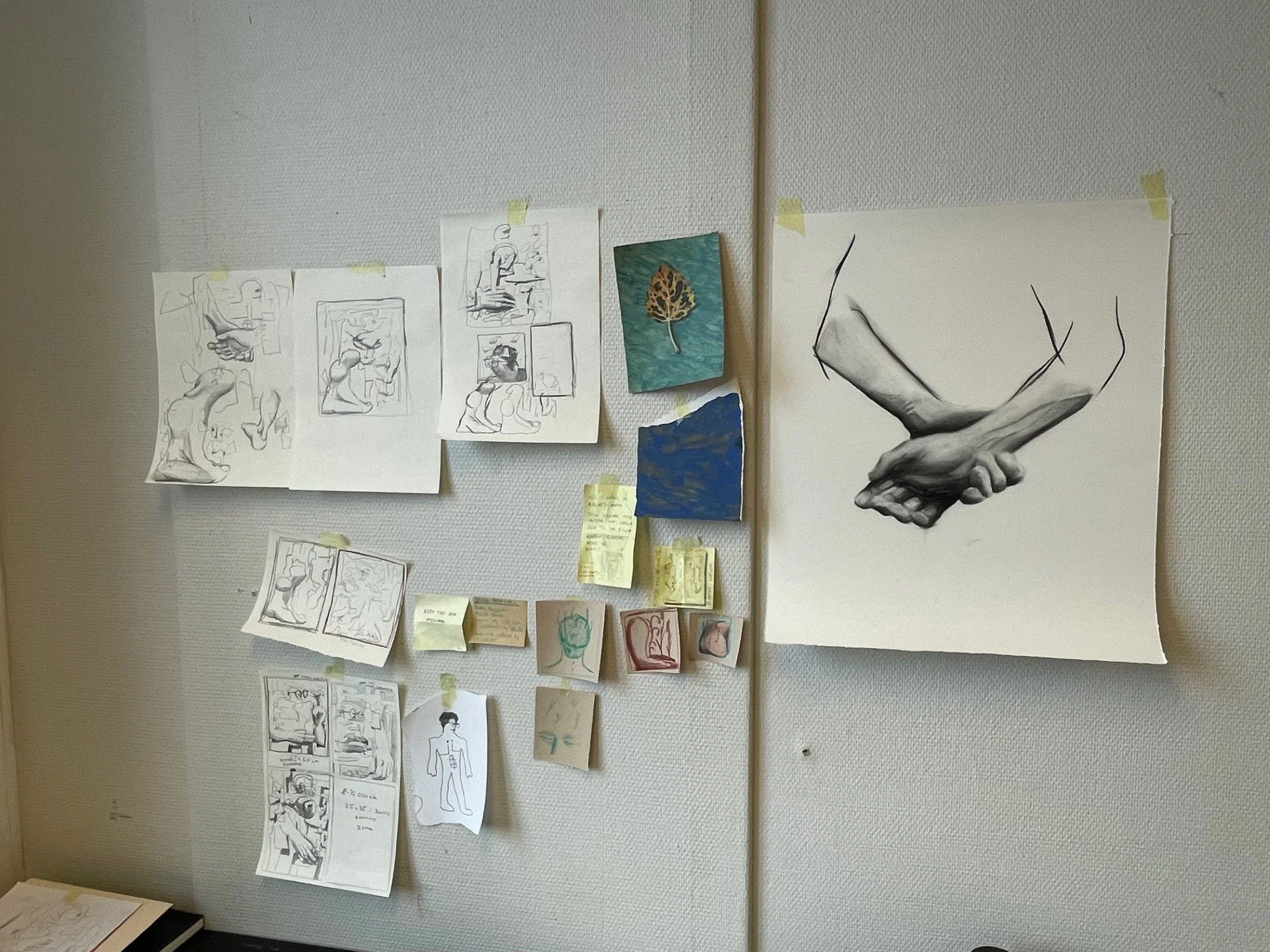
Inspiration is about actively seeing or experiencing for me. I feel the most inspired when I let art work its way into everything, for example in the way a wet old tree trunk is covered in green moss. Walking home from the gym through Slottsparken is usually where an idea appears, so I do my workouts in the morning, followed by going to the studio and sketching. I either listen to podcasts or music while working, often repeating the same album, or I simply work in silence depending on the day. With music it’s about the mood and letting it guide the work.
Music is a big source of inspiration, especially lyrics. I’ve been listening to a lot of Nick Drake, Veslemøy Narvesen and Adrianne Lenker lately. In one of Nick Drake's songs he sings «And I was green, greener than the hill - where flowers grew and the sun shone still». Out of those lyrics, visual ideas form. So I’m interested in sort of capturing the essence of the atmosphere or the feeling a particular lyric might evoke.
Is there something you’re trying to explore or understand through your art?
I’m interested in the human condition—what it means to exist in a physical body while also having access to something so abstract as thought and emotion. I draw inspiration from psychology, philosophy, Eastern religion, and conversations around embodied experience. My work often tries to map or translate these ideas onto visual form. For this exhibition, which revolves around growth, I was inspired by the metaphorical joining of the body and the nature in which it surrounds itself with.
Do you begin with a clear idea, or does the work develop as you go? What do you do when you feel stuck?
I sometimes start with a fully formed idea, and sometimes it becomes through the making. Some ideas have been with me for years, but executing them takes time and experimentation. I think a lot of the work is just iterations of earlier work, always about the human condition. I’ve made a lot of terrible works, and sort of having to develop this mindset of that being a necessity to become better at the craft. I don’t really think of those periods as being stuck—I just keep working, albeit frustrated. Something I probably learned from my mother being an art teacher.
Is there a particular work in this exhibition that means a lot to you?
There’s this work called “Framvekst” which I’ve made both a small drawing and a big painting of. The idea came from talking to a friend about fragmented figures in art history, like you see in Cubism for instance. I’ve always associated fragmentation with brokenness, and so I wanted to do a more positive spin on that idea. I’m very interested in contrasting, emotional tension, and so the broken figure became this way of dealing with the tenderness, beauty and hope of healing after having been ripped to pieces. “Framvekst” also refers to the Japanese tradition of Kintsugi, where repairing the cracks of for example a vase with gold highlights the beauty of the object's history.
What do you hope the audience take away from your work?
I hope people can become aware of the potential of art—both visually and emotionally. I hope it can lead them to appreciate color and materiality, but also to feel something in relation to the imagery. I hope that you feel inspired, that’s mainly what I value the most when I see other peoples work.
What kind of relationship do you have with your audience?
I try to keep the focus on the art, and what experiences the art can create for others. Many of the people who engage with my work are friends, family or colleagues from the art world, as well as strangers that follow me through social media. And so I’m grateful for having an audience, and love when the work connects with them. I’m not all that interested in speaking about myself, as an individual, so I love that the art can speak about something more universally human. I’m often quite interested in hearing how people interpret the work, about what it evokes in them.
Stay tuned for more from this upcoming artist!
Instagram: @ilnoem