Get to know: Mingshu Li
SKOG’s interns recently had the opportunity to talk with Mingshu Li about her upcoming exhibition and her artistic practice. Let’s dive a bit deeper together!

Mingshu Li is a Chinese-born ceramic artist currently based in Norway. She began her formal artistic training in China, earning a Bachelor of Arts in Ceramic Art and Design from the Guangzhou Academy of Fine Arts in 2016. She later relocated to Norway to further her practice, graduating with a master of Art in Art and Craft from the Oslo National Academy of Arts (KHiO) in 2020.
In her practice, Mingshu explores non-traditional approaches to clay, working primarily with stoneware and porcelain.
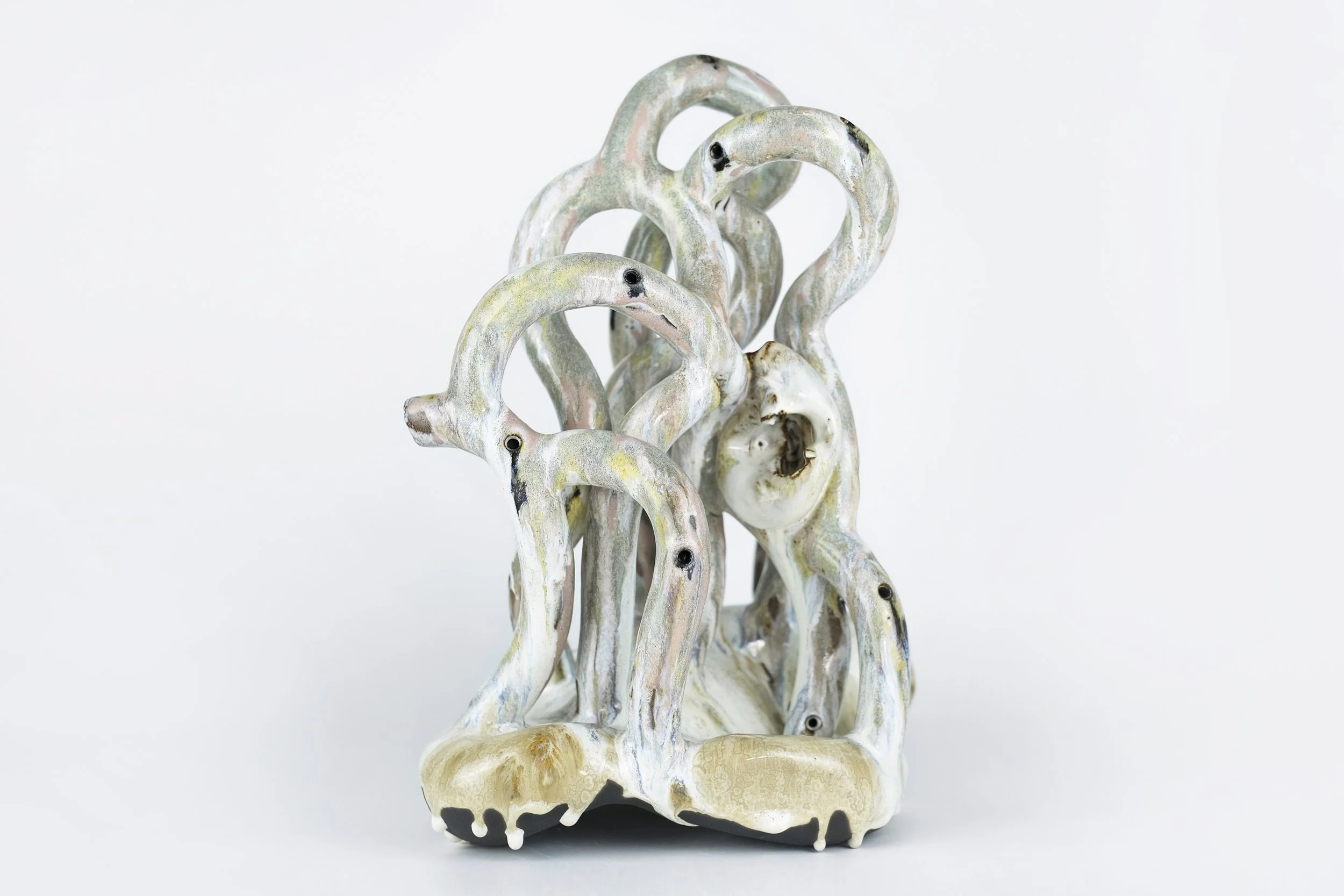
The latest exhibitions at SKOG Art Space includes Mingshu Li`s project «The Strawflower`s Journey». Her ceramic works are at view until 3rd of May 2026.
Q1. Could you tell us more about your background and how your practice has evolved?
Mingshu explains that her background is deeply rooted in traditional Chinese ceramic training. During her four-years Bachelor’s degree in China, she was taught to focus strictly on the shape, the technical structure of the sculpture and the movement between light and shadow. However, she notes that her current exhibition marks a significant shift in her practice. She now aims to infuse more narrative and storytelling into each piece. While she strives to create her own unique visual language, she hopes viewers can still clearly see a trace of her cultural origins in her work.
Q2. What is the inspiration behind your series, The Strawflowers’ Journey?
Mingshu Li shares that the inspiration behind The Strawflower`s Journey started during an artist residency in Porsgrunn three years ago. There, she became familiar with Porsgrunn Porselensfabrikk`s strawflower motif. She dived more into the history of this blue and white pattern, and found how it has migrated across cultures for over 200 years. She also made a parallel between this cross-cultural migration and her own experience as a Chinese artist relocating to Norway. When her library research yielded few written records about the motif’s exact origins, she decided to use clay to “fill the gap” in the history books, crafting a visual story to complete the narrative of its journey.
Q3. What is the story behind the pieces full of holes in the pieces from Dropping Seeds series and The Strawflowers’ Journey #12?
Any ceramic piece needs to be hollow and have a little hole for the hot air to escape the piece during firing, otherwise it can blow up. Mingshu has been trained to hide the hole and it was a part of making a ceramic piece process. Until she questioned herself “Why do I have to hide it? Can I just make the hole become part of the work?”. The works from the Dropping Seeds series embrace the holes as the surfaces of the pieces are filled with holes.
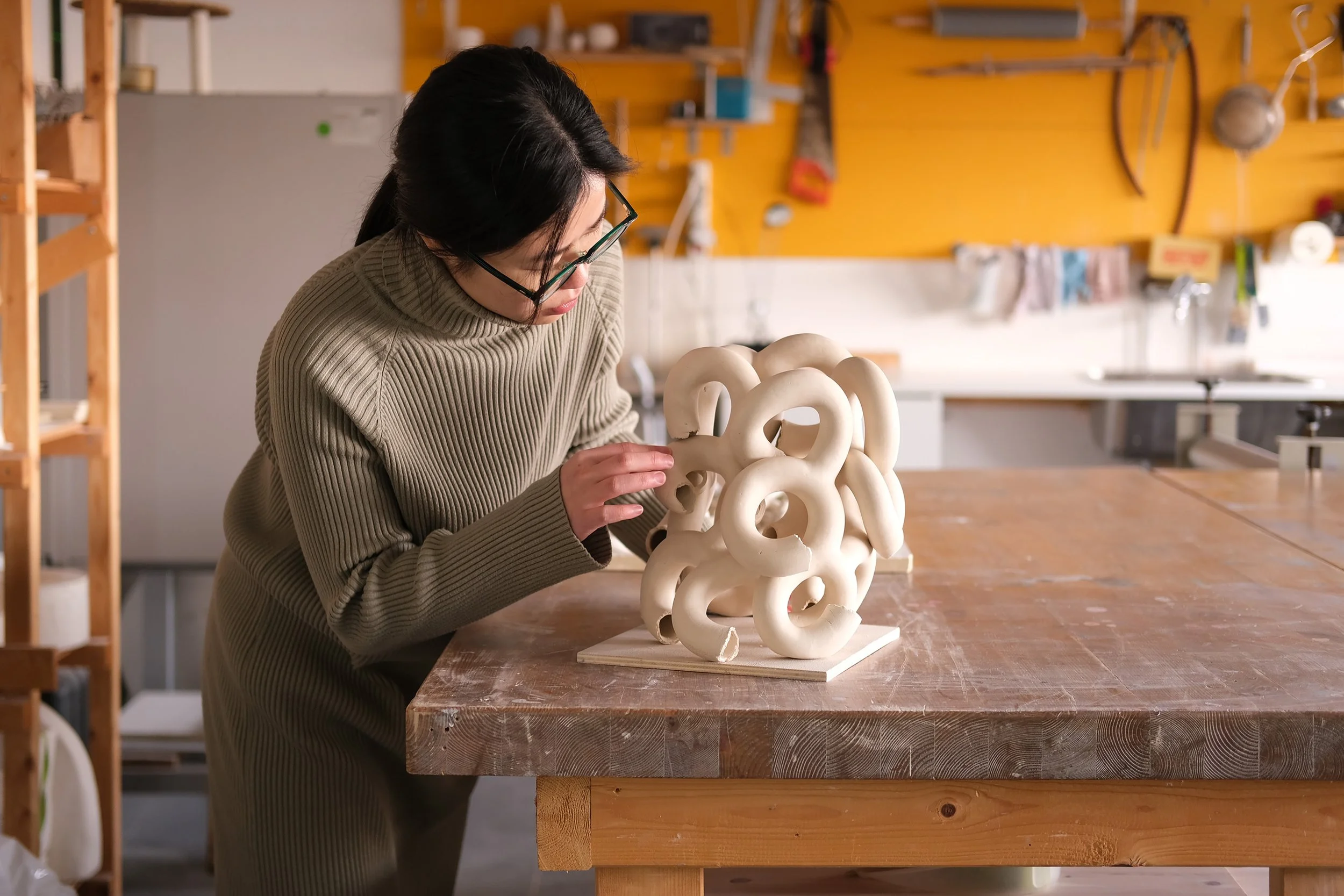
Mingshu Li in her studio.
Q4. Your glazes have a very unique, almost “melting” quality. Can you tell us about that process?
Mingshu highlights the unpredictability of the kiln as her favorite aspect of the craft. She uses a material that sits somewhere between a glaze and a clay, but under high temperatures, it completely melts and transforms. She describes this as a risky process where the outcome is always a mystery as sometimes it fails, but with a bit of luck, the chemical reaction results in a beautifully organic texture.
Q5. To finish, you also had a project titled, “Why do Europeans put plates on the wall?” What sparked that question?
This project, stemming from a previous collaboration, was sparked by a simple internet search. While researching on a Chinese search engine, Mingshu stumbled upon the question: “Why do Europeans put plates on the wall?” She explains that in Europe, porcelain was historically referred to as “white gold” which is a material so precious and expensive that people displayed it on walls to show their wealth and power. In China, however, porcelain has traditionally been treated as an accessible material used every day for eating and drinking.
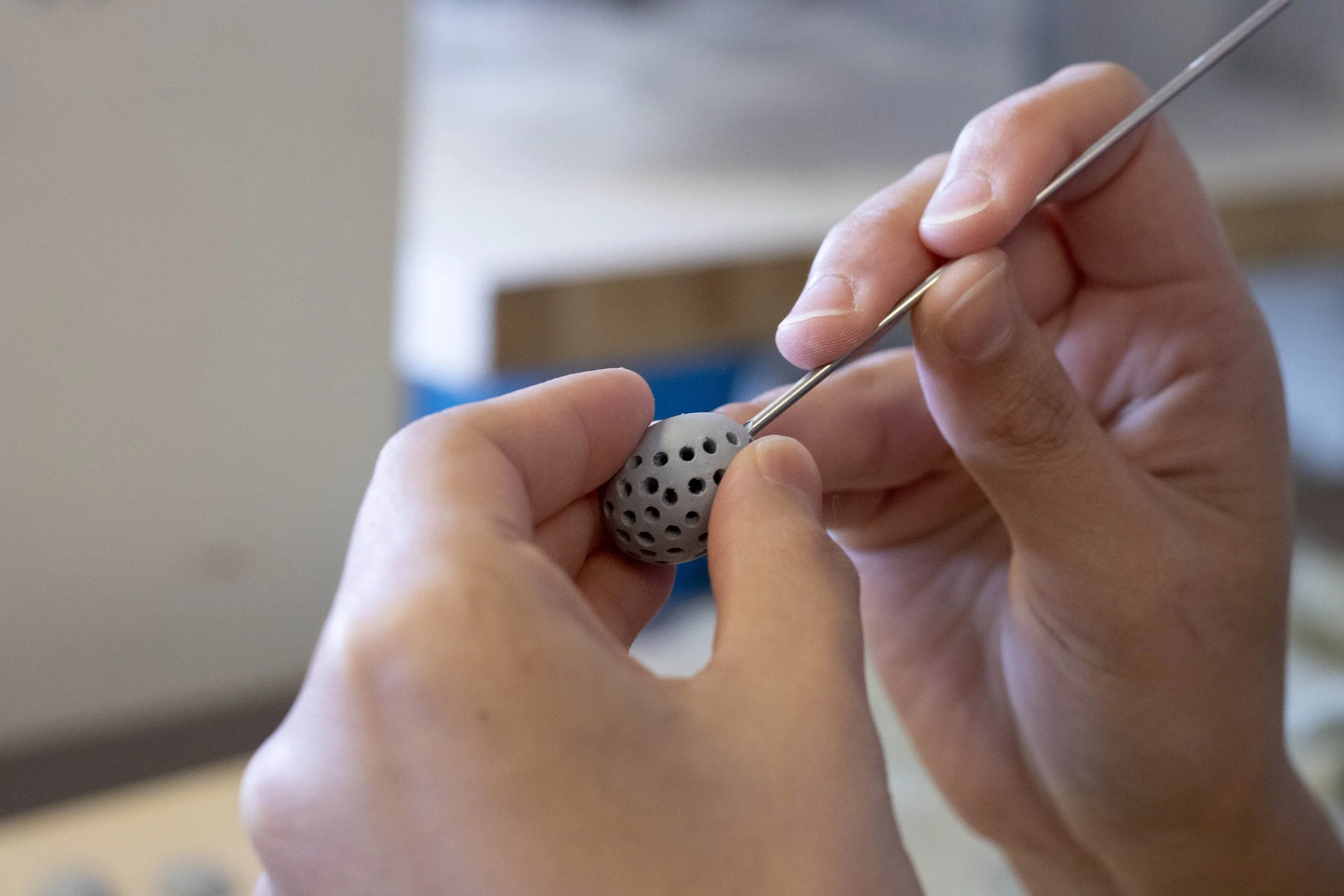
Mingshu adding some details on a piece for the Dropping Seeds series.
We hope this deep dive into Mingshu’s world has given you a new perspective on her unique visual language and the stories hidden within her clay. Come visit us at SKOG to experience The Strawflowers’ Journey in person and see these fascinating pieces for yourself!
Visit the artist’s website to stay updated on her upcoming exhibition!
Written by interns Sofie, Darja and Marina.